

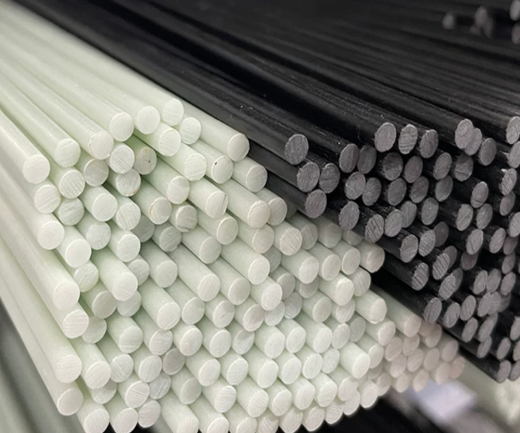
1.Light weight & high strength, low elongation: Its specific gravity is much lower than steel, featuring high tensile strength and low elongation at break. It bears tension during optical cable laying and aerial installation to protect optical fibers from breakage.
2.Insulation & free from electromagnetic interference: Made of non-metallic material, it is non-conductive with no induced current and offers excellent lightning protection. It can be laid alongside power cables without affecting optical signal transmission.
3.Corrosion resistance & anti-aging: It will not rust like metallic strength members. Resistant to acid, alkali and moisture, it adapts to harsh environments such as outdoor areas, coastal regions and underground pipelines, extending the service life of optical cables.
4.Good thermal stability: Low linear expansion coefficient, minimal deformation under high and low temperatures, and not prone to brittle fracture at low temperatures, ensuring stable geometric structure of optical fibers.
5.High dimensional accuracy: Smooth surface and small diameter tolerance. It has good compatibility with optical cable loose tubes and filling compounds, facilitating extrusion processing of optical cables.
6.Good elasticity: Resistant to breakage under moderate bending, meeting the requirements for optical cable coiling and bending during construction.
Materials with other characteristics – please inquire separately.