

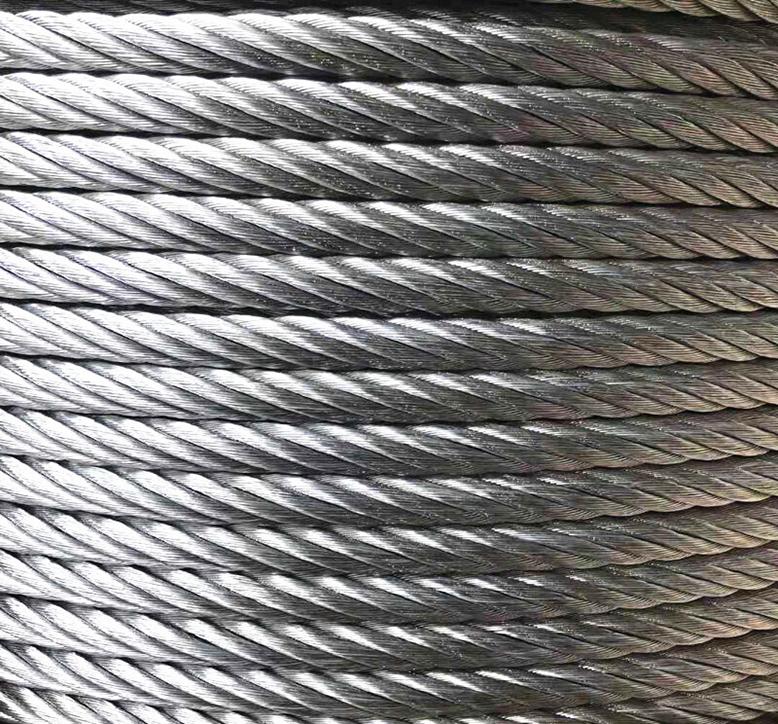
1. High tensile strength, high elastic modulus and low elongation: It is stranded from high-carbon steel wire and deforms slightly under tension. As the strength member/messenger wire of optical cables, it resists tension during laying and aerial installation to protect optical fibers from tensile damage.
2. Galvanized for corrosion protection: The surface is coated with hot-dip galvanized or electro-galvanized layer. The zinc layer provides sacrificial anode protection, resisting oxidation and atmospheric corrosion, making it suitable for outdoor aerial environments. The zinc layer features strong adhesion and does not easily peel off when bent.
3. Stable structure and uniform stranding: The common 1×7 structure (the mainstream type for optical cable strength members) boasts high dimensional accuracy, smooth cabling processing and good straightness.
4. Moderate flexibility: It can be bent and coiled to facilitate optical cable production, pipe threading and aerial construction. However, as a rigid strength member, it cannot be repeatedly bent at a small radius.
5. Electrically conductive and magnetic: The steel substrate is conductive, which brings lightning diversion risks in lightning-prone areas. This explains why FRP non-metallic strength members are adopted for some optical cables.
6. High temperature resistance and stable mechanical properties: Its mechanical properties barely change under normal temperatures. Its disadvantage lies in the obviously accelerated corrosion rate in environments with strong acid and heavy salt spray (seawater).
7. Cost-effective: It has a lower cost compared with stainless steel and FRP, serving as the most widely used metallic strength member for outdoor optical cables.
Materials with other characteristics – please inquire separately.